End No End
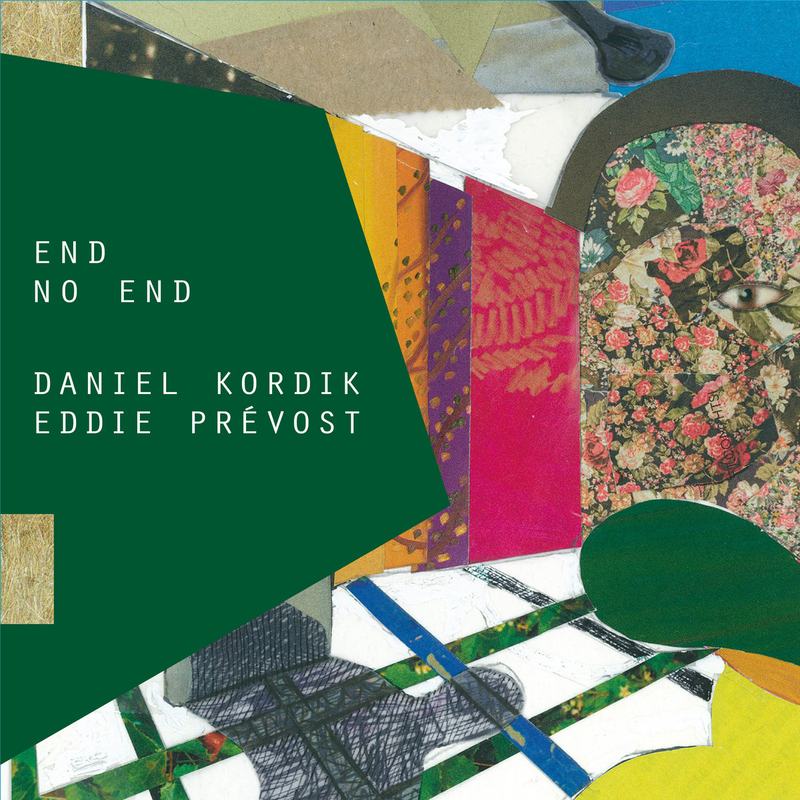
Daniel Kordik: Synthesiser
Eddie Prévost: Percussion
End No End
I met Daniel Kordik at Eddie Prévost’s workshop. Straight away, Daniel impressed me with his adaption of the Vostok analogue synthesiser to the circumstance of free improvisation. He encouraged me to think more about the electric guitar as a sound generating device and, in particular, its electrical aspect: electric guitar players play electrons. I call that ‘guitarism’. Anyway, what really hit me with Daniel was when he moved over to digital and FM synthesis. We released a couple of duo recordings on Confront and Superpang but, as heard on this recording, Daniel develops a sound world that dovetails beautifully with Eddie’s percussion. I’ve already written of Eddie as a supreme metallurgist (Industria by AMM), but in this recording you can really hear the subterranean aspect of that: the metalworker toils under the surface of the earth, in a hole in the ground. Between them, Daniel and Eddie explore an ecological music, one that unfolds at a slight remove from the anthropocentric, and which touches on elemental forces indifferent to us but upon which our survival depends. Terrifying and hopeful, somehow.
This music is laminal improvisation. Laminal might still be a good word but, as noted, I hear it as a laminal earth, the sliding compression and release of strata, the geology of morality. Because there is a morality involved, a practice that understands that this music does not come from nowhere, and certainly not from the mind of an ‘individual’ genius. Rather, this music grew, and we hope to tend it as best we can: to foster and follow. The providence of an indifferent earth and, beyond that, an indifferent cosmos. Here, we will find a home of sorts.
More technically, perhaps, the current state of the art might fall into a duality of ‘form’ on the one hand, and of ‘sound’ on the other. Improvisation that understands form as the key thing in music, that orientates itself to form by extending it, refining it, complexifying it, departing from it, mixing it, and so on, pre-supposes music to be structured like a language. What is form? A set of negotiated norms and rules, a playing with expectations, an ironic gesture (sometimes). Without doubt, from the world of improvised music and its others, form has provided great riches. The danger, though, is that form becomes the thing, an over-formalisation of how one gets out of, and around, form itself. Ultimately, form probably does not need sound at all (cf. Milton Babbitt).
In contrast, sound occurs without form yet also generates form through the structure of its own unfolding. With sound, we might say (to borrow from the synthesists) that it is the envelope of sound that provides form. More specifically, though, it is the timbral grain of sound that generates its own ordering and, with this, allows for a completely different attitude towards time. A non-formal time, neither linear nor circular, but emergent. Something both extremely slow (at least 4.5 billion years in the making) and extremely fast (you can only hear it afterwards). The immanent time of the virtual: something non-human that is intimately connected to humanity.
When asked the definition of time, William S. Burroughs responded, after some thought: ‘time is that which ends.’ We extrapolate time because we perceive change - yet, only because there is an emergent time, internal to itself, do we exist to perceive such change. Whilst we are here, we should understand that we are all here: this is the lesson of our eventual extinction. If we imagine a perspective located at the end of humanity, how can we see ourselves as anything but equal, as brothers and sisters, kith and kin? What we share in common is that humanity will not be. That is why, whilst we exist, our eventual end should be for us, now and in the present, no end at all.
To our leaders, to the necropolitical, and to the 1%, hear this now: the geological music of morality. Time is not your so-called ‘growth’.
NO Moore, March 2024
Recording: Edward Lucas at All Saints, High Laver
Mastering: Rupert Clervaux
Cover Art: Ross Lambert
EAR023